

Most security teams we talk to are already sold on the idea of canaries and the value they can provide. In fact, we've seen an increase in this awareness with the advancement of AI-assisted attacks (or sometimes autonomous "explorations" like the OpenAI Hugging Face incident). Teams are increasingly seeing the value canaries can provide when an AI-agent moving at machine speed is enumerating through your environment. So security teams have accepted that a breach will happen at some point and know dwell time is the number that decides how bad it gets. What stops them, however, is the blank page. They look at their entire estate, all of the cloud accounts, the clusters, the managed laptops, and the developer environments and see a mountain of work between where they are and the idea of full coverage that "must be required" in order for deception to work. All of which perpetuates the myth that deception is a very complex project that requires a lot of ongoing overhead to maintain. It is a myth, and we can say that emphatically.
At some point, you'll want to develop a strategy to ensure you're capturing the right coverage, but for now we recommend keeping it very simple, something we outline in our own Security Canary Model.
Myth or not, these fears are still justified, and we hear them a lot. But the reality is that deception delivers value from just a single well-placed canary. And with every canary placed after your first, the value continues to grow. You don't need an end-to-end strategy or to get "full coverage" in order to get "full value". You need one credential, in one place an attacker is likely to look, wired to an alert that reaches your team. Something that can be done in a single afternoon. One small step, followed by another.
Meet Meridian
To keep this concrete, we'll follow a company through the decision. Meridian is a 1,800-person business selling a B2B analytics platform. They run entirely on AWS across a few hundred accounts, with workloads on AWS Kubernetes EKS, Okta for SSO, and engineers on Iru (Kandji) managed Macbooks. Their security team is around half a dozen people and includes a small detection and response function. They've been working through revamping their application security program, due to a recent event where a developer's laptop was compromised by (they think) a supply chain attack. Their goal is to put security scanning tools closer to the development side starting with the CI/CD pipelines. However, this project's going to take several months to complete as they swap vendors, enable their devs, and achieve coverage across engineering.
They're a very capable security team, dealing with issues you might find quite familiar. While your environment will differ in the details, the reasoning still largely applies.
(Meridian is an invented company for the purposes of this story.)
Why Meridian hasn't started canaries
Meridian's team responds to alerts every day and runs a program most companies their size would recognize. So why no canaries yet? Three reasons that go beyond just, "we're not ready."
First, the whole estate at once looks like a massive project (and they're not wrong). Currently, AppSec in development is kicking off, Identity hardening is always ongoing, there's a patching backlog, and their SIEM is currently too noisy. They've read the idea of "Roll out deception everywhere," and so it too joins that list but never reaches the top.
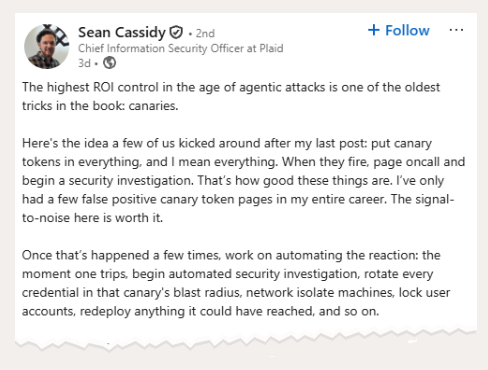
Second, they worry about additional noise. A team that already works a full triage queue is right to be sceptical of a new alert source. Nobody wants another integration that pages someone at 2am for something benign and then needs weeks of tuning before it settles.
Third, they worry about touching production. They're already in the middle of a project that's inserting security tools into developer environments. Anything that goes near developer machines or live cloud accounts carries some risk of breaking something, and "we added fake credentials and something broke in the process" is a sentence no one wants to say.
Underneath all three is the same fear: if we can't do this properly across everything, let's wait until we can. The fear is what keeps it as a roadmap item that never gets prioritized.
Start by friction, coverage comes with time
The way out is to pick your first canary by how little it costs you to stand up, and let coverage follow. When we help a team decide where to start, we weigh three things for each type of canary:
- how much effort it takes to deploy
- how clean the signal is when it fires
- how much of the attack surface it covers.
Most canary types trade one of those against another. Workstation canaries are the rare type that scores well on all three - highest on ease, broad on coverage, and high on fidelity.
The workstation canaries go out through the MDM you already run. There's no new agent and no additional endpoint project, one person pushes them the same way they push any managed configuration. They cover the entry point behind a large share of real intrusions: stolen or harvested laptop credentials, the exact move groups like Scattered Spider make with off-the-shelf infostealers.
A canary credential on a laptop can catch multiple problems: an external attacker who has landed on the device, a malicious insider, and, increasingly, an AI agent enumerating whatever it can reach.
As far as the additional alert noise? A canary credential on a laptop is not something a person has any reason to use.* Credential-harvesting tooling reads it, but your engineer never does. That's a different kind of signal from the anomaly detection your team spends its week tuning. When a canary fires, you know something is wrong. Josh Yavor, former CISO and CEO of Credible Security, put it well: "absence of signal is actually a delightful change."
The speed to value from the start holds up under real pressure, too. When Riot Games ran a red team exercise, Tracebit canaries flagged the engagement at the start, not days later in a log review.
We recommended that Meridian start with workstations and rolled them out to all 1,800 workstations on day 2 of the pilot. And since they had a recent incident with a compromised developer workstation, this provides them really fast coverage while they continue to work towards rolling out their AppSec changes. Deception works while other security programs are being changed, refined, or better tuned.
* A quick note for the astute observer, we said "a canary credential on a laptop is not something a PERSON has any legitimate reason to use" and that's true. With the increasing use of AI agents, we had seen false positives grow as they're prone to enumerating all credentials when they're working on a task involving public cloud services. As such, we've built in some features that deter approved internal agents from trying canary credentials. We've seen this lower the false positive rate for customers.
Deploying your first workstation canary
Setting up the first one in Tracebit is much closer to a simple configuration change than a full on new security tool deployment. Meridian, being standardized on Apple for their devices, naturally uses Iru as their MDM of choice. From the Tracebit dashboard, they navigate to the workstation canary module, choose the Iru canary type, and a simple script is built for them to attach. This script is pointed at a single device to start, and the canary credential gets pushed out to the machine looking like an ordinary set of stored credentials.
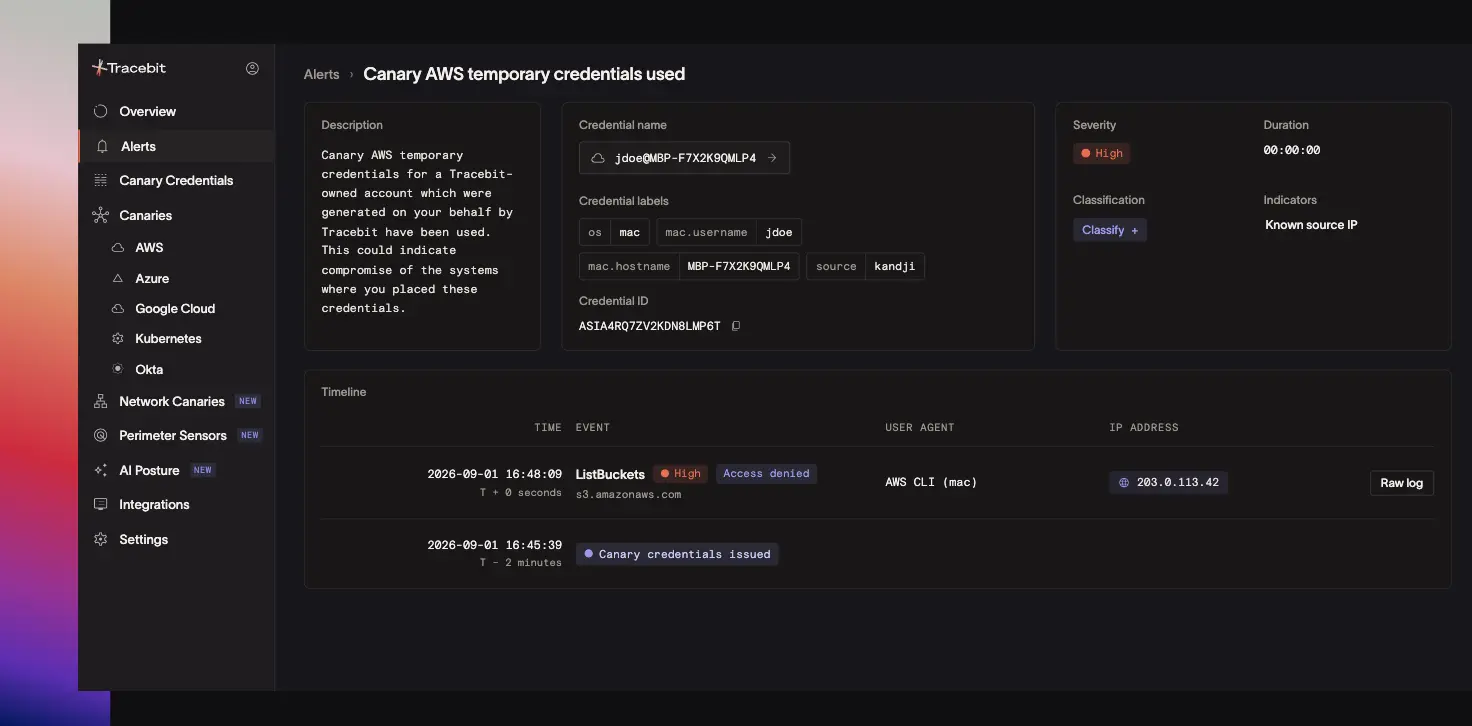
And that's it. A single canary pushed to a single workstation, now serving as a tripwire in the event that machine is compromised. From then on the only time you hear anything is the moment it's read, and when that happens the alert arrives with the context you need to act on it: which device, which credential, and when.
Scaling to the rest of the fleet
Once the first canary is live and Meridian trusts the alert is working, widening to every other laptop costs almost nothing. It's the same MDM push, so there's no extra per-machine effort and their whole fleet is covered in one motion.
This is the point where Meridian was able to breathe a bit. The thing they'd been viewing as a massive project turned out to be a setting, the additional noise they feared didn't show up, and they now have detection on every endpoint in the company, which is more than a lot of far larger deception programs ever get to. They know, while they're rolling out additional security measures, that if one of these canary credentials is touched they can respond even faster.
Leveling up: Crawl, Walk, Run
With workstation canaries live, Meridian is already getting value from deception. Each next step adds coverage using deployment tools their team already runs. Tracebit helps them decide where to go next, at a pace that fits their priorities.
Crawl: Start with the easiest wins
Cover the devices engineers work on and the pipelines they build with.
- Managed workstations: Where Meridian started first, pushing canary credentials through the existing MDM. A simple script and configuration change can extend coverage across the fleet.
- Build pipelines: Add canaries through GitHub Actions, GitLab CI/CD, or CircleCI using a script or action in the existing build process.
Meridian now has tripwires in two places attackers commonly target, without introducing a new deployment system.
Typical rollout: 1–2 days.
Walk: Reach deeper into sensitive systems
Next, Meridian extends coverage to its Kubernetes workloads and browser sessions.
- Kubernetes: Mount canary credentials into pods to flag unexpected access. Tracebit's AI capabilities analyze the environment to help create convincing decoys that resemble production assets.
- Browser sessions: Deploy the Tracebit Chrome Extension through Chrome Enterprise to place Cookie Canaries in managed browsers, adding a tripwire for session theft.
These additions bring detection closer to the workloads and sessions an attacker could use to move further into the business.
Typical rollout: up to a week for this stage.
Run: Expand across cloud, identity, and perimeter
With those foundations in place, Meridian adds coverage across more of its environment.
- Cloud resources: Deploy decoy buckets, roles, and secrets across AWS accounts. A few lines of Terraform can extend coverage to hundreds of accounts using the infrastructure tooling already in place.
- Identity: Add an Okta canary tile to the dashboard, creating a decoy that legitimate users have no reason to open.
- Perimeter: Set up fake login portals with Tracebit's perimeter sensors to detect attackers probing the edge of the environment.
Each addition creates another opportunity to spot an attacker and another resource they have to avoid touching.
Typical rollout: many customers complete their broader rollout within a month, depending on the size and complexity of their environment.
You don't need to reach "Run" to see value. Start with one working canary, then build coverage where it matters most to your team.
Start small
Remember, the goal is simple and focused. Start today and get one real canary live in an afternoon, on a free trial, and let the first easy win make the case for the next step. Meridian with their developer workstations covered, now they have a fallback in place while they continue to adjust their AppSec program. And, well after they've strengthened that program, Canaries continue to provide a layer of protection and awareness in the event that the program ever falters or something new slips by their scanners.
That first credential also changes the math for you as a defender. Before your first canary, an attacker had to be right just once. But now? Now, an attacker in your environment has to be right every… single… time. They only need to touch one canary to give themselves away, and they can't tell which resource is real and which is bait. The math continues to get better in your favor the more you continue to deploy.