
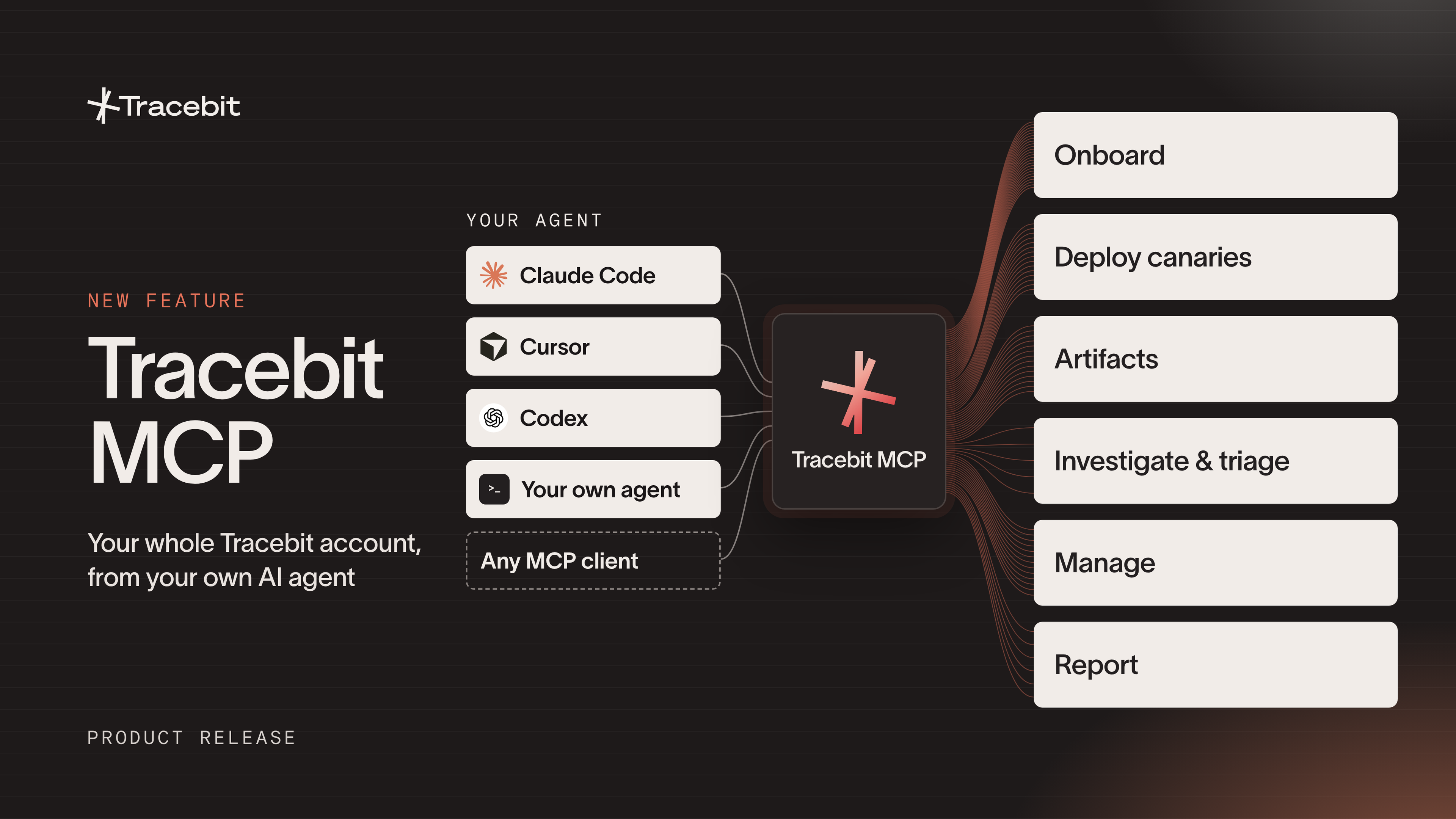
We're excited to launch the Tracebit MCP server, a gateway that connects your own AI agents to the Tracebit platform. Now you can connect your favourite AI agent to your Tracebit instance, giving your agent the ability to create our new Tracebit Artifacts, configure and deploy canaries, triage and investigate alerts, and create reports. Everything you can do in Tracebit, your agent can now do for you.
Attackers are already using AI to assist their efforts in breaching your environments. We want to give some of that power back to you, letting AI do the heavy lifting in strengthening your deception posture even more.
And with our most recent release of Artifacts, your agents have access to some of the most powerful deception tools in the industry.
Deception works best when it's spread across your environment, blends in, and is refreshed as your environment changes. AI agents combined with the Tracebit platform make this possible at scale. They bring enterprise-wide context and continuously improving generation capabilities, helping defenders tailor their deception strategy to their environment.
Execute your entire deception strategy from your agent
Everything you can do inside of Tracebit, your agent can do on your behalf. Our MCP server broadens the flexibility of how Tracebit works for you, whether you want your agent to process one-off requests, access Tracebit as part of ongoing operations, or create MCP-driven integrations between Tracebit and any other system your agent can access.
Here are a few examples of what your agent can do through the MCP server.
Tracebit Artifact Creation: Partner with your agent to create new Artifact Templates in Tracebit, highly customized to look identical to your environment, without ever passing sensitive data to Tracebit. From those templates, your agents can create Artifacts that blend in perfectly, giving you broad access to our highest fidelity alerts.
Manage: Have your agent configure and deploy canaries, create canary credentials, and spin up Perimeter Sensors that mirror the services in your environment.
Triage and investigate: When you receive an alert, have your agent investigate the source IP, user agent, what the identity reached, and whether it was successful. It can correlate those findings with logs from your other tools, then classify the alert and explain its assessment with the evidence it found.
Reports: Ask your agent for a 30-day overview of your deception posture and it will tell you everything you need to know: accounts protected, canary deployments in place, alerts by severity and classification, coverage by provider, and open recommendations. A daily summary in Slack is one prompt away.
Artifacts + MCP server = powerful, flexible deception
Artifacts are decoy files that contain canary credentials or URLs buried within. These files look like every other file in your company's various environments, mirroring things like board presentations, payroll files, security assessment reports, SSH keys, encrypted PDFs, and browser session recordings. Once these files are found by an attacker or malicious insider, they will discover the seemingly valuable canary credential inside, and any attempt to validate or use the credential will trigger an alert.
Artifacts are most useful when they look identical to other files in your business, which your own AI agents have access to. Through our MCP server, your agent can create Artifact Templates in Tracebit, using your organization's context and the structure of your real documents to make them blend in. Your agent then uses Tracebit to generate new Artifacts from those templates, ready to be placed anywhere your agent can reach, for example a Google shared drive, a Salesforce support case, or a Vault secrets manager. Tracebit records where the agent stored the Artifact, so when that canary triggers, you know exactly where the breach occurred.
These two recent features represent our vision for the future of deception operations.
Deception operations: our vision for the future of defenders
Bad actors will continue to use AI to find previously undiscovered vulnerabilities, exploit defenses, move at machine speed through your environment, and extract data before your security team can piece the story together.
The future is going to require your own AI agents to actively mutate your defenses to keep up with the rapidly changing landscape of attacks. We believe one of your strongest lines of defense is going to be rapid detection, so your team can go back on the offense even faster.
Take a real attack. In August 2025, a group Mandiant tracks as UNC6395 used OAuth tokens stolen from the Salesloft Drift chat integration to pull data out of customers' Salesforce instances.
Salesloft later said the attacker had spent the months before in its GitHub account and then Drift's AWS environment, which is where it took the OAuth tokens.
Replay it with the Tracebit MCP server. Your team hands Salesloft's update and Google's advisory to its security agent:
Read Salesloft's update on the Drift breach and Google's advisory on UNC6395. Using Tracebit, develop a deception strategy to detect this group's techniques.
Your security agent:
- Reads Salesloft's update and Google's advisory to understand the attack path and identify where canaries could detect the same techniques in your environment.
- Creates a Perimeter Sensor, a decoy internal service mirroring a real one you host or use, such as an admin console.
- Uses your local access to understand how your engineers write deployment config, runbooks, and READMEs, then creates decoy versions as Artifacts with canary credentials or URLs inside. It includes the Perimeter Sensor's URL and a login in a runbook, the way an engineer leaves a note for the next person on call, and commits the Artifacts to repositories an attacker would download. It also places decoy browser recording files (HAR) from a "debugging session" in those same locations.
- Records each placement in Tracebit, so an alert tells you which repository or account the attacker reached.
All of this happens in less than an hour.
Over time, your agent can check in with Tracebit, verify where the Artifacts were placed, and ensure they're refreshed or replaced to maintain their realism.
The next time an attacker gets into your source code or cloud accounts on the way to your customers, you hear about it from a canary, not from a customer or an advisory.
Tracebit APIs are expanding to cover all product functionality
In order to build the Tracebit MCP server, we had to round out all of our APIs. We know you've been asking for these. So now, anything your agents can do with the MCP server, you'll be able to do with our APIs as well, bringing the Tracebit APIs to parity with what you can do within the UI.
Use the Tracebit UI, call the APIs directly, or let your agent work through the MCP server.
Take the new Tracebit MCP server for a spin
If you're already a Tracebit customer, you can give our MCP server a try today. Go to MCP > Connect and start with some of the example prompts.

Learn more
Live webinar
Build a deception strategy for your environment
Join Tracebit co-founders Andy and Sam to see how AI agents, Artifacts and Context Bombs work together in a live demo.
- See the latest Context Bomb research on slowing down AI attackers.
- Learn how to create Tracebit Artifacts and deploy canaries almost anywhere.
- Build and run your own deception strategy with AI agents.