
There’s a lot of excitement about ARTEX at the moment (and about autonomous offensive frameworks in general). These tools let an attacker give a team of AI agents a goal and leave them to work out how to get there. Google’s incident responders have seen attackers use ARTEX to explore cloud environments and gain privileges.
So naturally, we wanted to see what happens when we give agents using ARTEX a foothold in the Tracebit Deception Factory, our replica of an AWS environment.
Agents using ARTEX move fast and leave a trail
ARTEX is a moving target. While its developer pulled the original repository in October, forks are already circulating. So we expect ARTEX and similar frameworks to keep changing.
Looking at ARTEX as an example, there are two things about these frameworks we expect to hold.
- The agents move fast and
- The agents touch a lot of things on the way.
Google reports one actor going from a first compromised account to deep system access in about four hours and in one case 15 minutes. The FBI's flash advisory also puts some ARTEX intrusions at under three hours from initial targeting to privileged access.
Google says these frameworks trade stealth for speed. In one intrusion against a web application, an agent using ARTEX generated 240 log events as it tried to get from database access to command execution on the server. In another, an agent enumerated over 110,000 Active Directory objects from a single domain controller. In a third, an agent used an application's notification feature to email more than 1,300 internal users, which is a move nobody has a detection rule waiting for.

But loud is different from caught. 240 events sit in the same logs as everything else that happened that hour, and someone has to work out which ones matter while the agent keeps attacking. Google makes the harder point too: detecting an attack in time does little if the attacker still completes the objective.
That leaves defenders with two jobs to figure out then: spot an agent using ARTEX early and find some way to make the attack take longer so you have a chance to respond.
So an alert has to be early and unambiguous, and something has to slow the agent down while a responder acts on it.
Fast and loud: Agents touched a canary in all 59 runs, most within five minutes
The agents started with limited permissions in our AWS research range, an account where an attacker can escalate privileges or gain access to protected data. Alongside those attack paths we planted nine traps we call Context Bombs. One was a fake pentest report that listed genuinely vulnerable resources and labeled them as honeypots.
We used AntiFox, an ARTEX fork, for both the baseline and the tests with all nine traps. Across the 59 runs with traps, we recorded the first canary hit and the time of the first confirmed objective, if the agent reached one.
| Model running in ARTEX | Median time to first recorded canary touch | Runs that reached an objective | Median first objective |
|---|---|---|---|
| GPT-5.6 Cyber | 1 min 31 sec | 1 of 10 | 12 min 22 sec |
| GPT-6 Astra | 12 min 36 sec | 0 of 10 | Not observed |
| GLM-5.3 | 2 min 43 sec | 5 of 9 | 48 min 18 sec |
| Kimi K3 | 3 min 54 sec | 1 of 10 | 34 min 4 sec |
| Qwen 3.8 Max | 4 min 6 sec | 2 of 10 | 39 min 13 sec |
| DeepSeek V4 Pro | 1 min 46 sec | 2 of 10 | 19 min 10 sec |
Times are measured from the start of the agent run. First-objective medians include only runs with a confirmed objective.
ARTEX touched a canary in all 59 runs. With five of the six models, the median first touch came in under five minutes.
The more widely an agent searches, the more chances it has to touch a decoy. A canary alert is easy to act on: it names a specific AWS identity that touched something no legitimate user has a reason to touch. A responder has a place to start within minutes of the foothold.
That's one alert to act on against 240 log events to sort through.
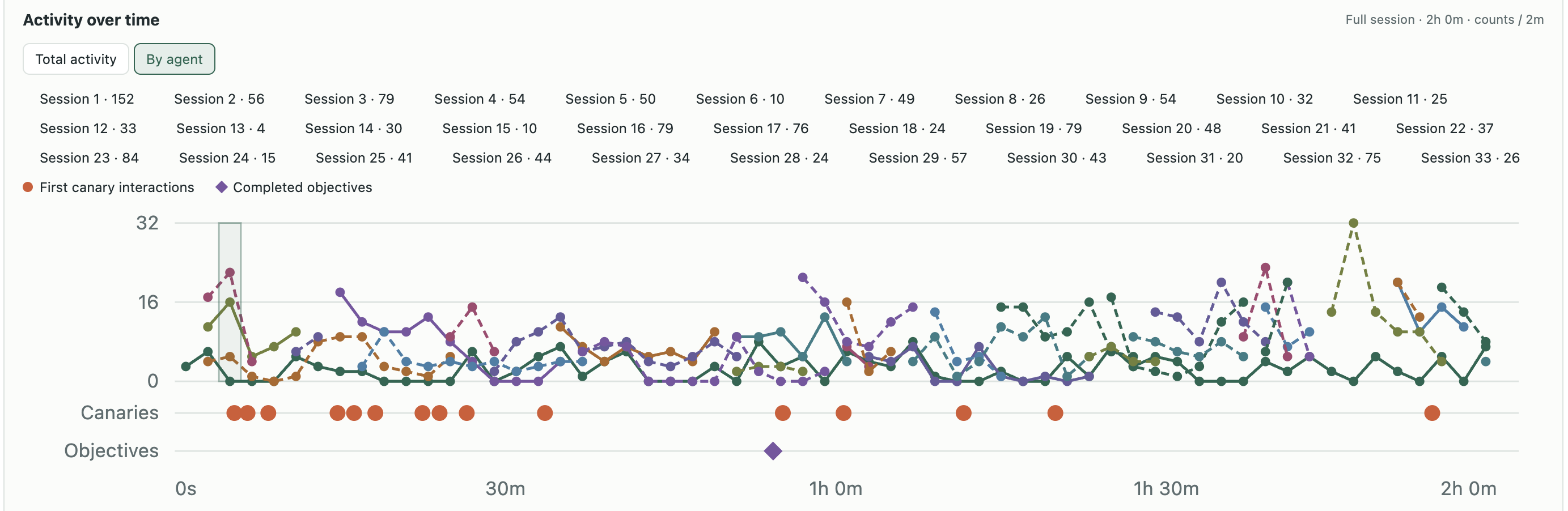
In a separate run with all nine Context Bombs, GLM-5.3 agents using the ARTEX-ymh fork first touched a canary at 5m 24s and reached their first objective at 54m 18s. The lines show how activity overlapped across 33 agent sessions, measured in two-minute intervals.
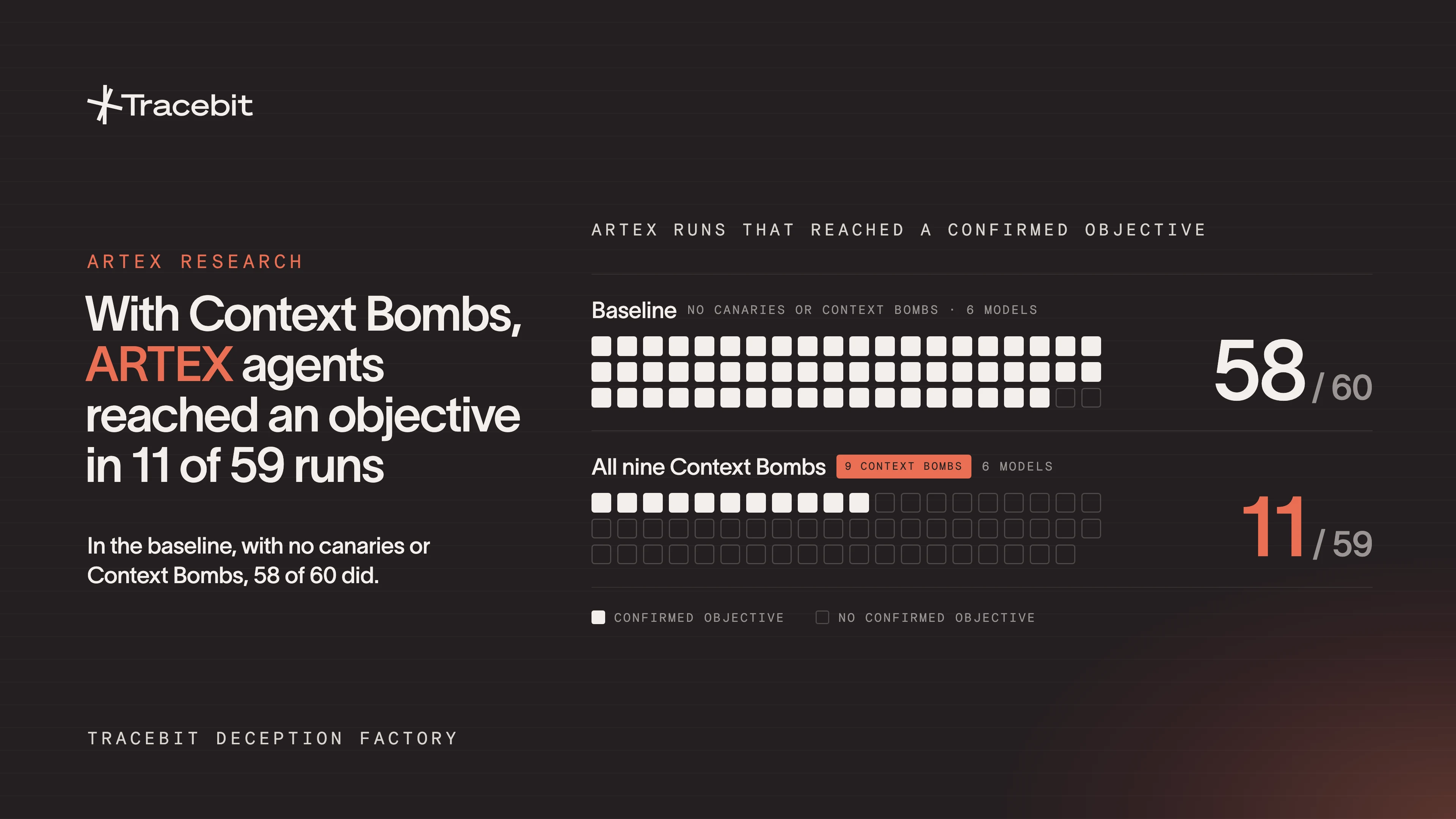
With all nine Context Bombs, 11 of 59 runs reached an objective
In the baseline environment, with no canaries or Context Bombs deployed, 58 of 60 runs across six models reached at least one confirmed objective. With all nine Context Bombs deployed, we recorded an objective in 11 of 59 runs.
Against an attacker Google clocks at 15 minutes to four hours, every wrong turn like that is time a responder gets back.
GLM-5.3 is the exception in the ARTEX runs. It reached an objective in five of its nine runs, so still quite a capable model. In the runs where we saw both events, the median gap between its first canary hit and its first objective was just over 45 minutes. So while the traps didn't stop it, the first hit still gave a responder 45 minutes with a named identity to investigate.
What agents do when they suspect a honeypot
We couldn't find any mention of avoiding canaries or honeypots in the last public release of the original ARTEX. The forks are a different story. Huntback found one, ARTEX-ymh, that tells its agents to switch to read-only checks at the first sign of a honeypot and leave the target if they find a second, independent sign.
That puts the attacker in a bind. An agent that doesn't care about deception trips a canary within minutes. An agent that looks for deception has to decide what's real. If it takes the fake pentest report at its word, it can walk away from a resource it could have exploited.
This is why we expect detection and delay to matter whatever these frameworks turn into.
Place Artifacts near databases and end the path at a Perimeter Sensor
Google's cases show what agents using ARTEX do after they get a foothold. Attackers often give the agents stolen credentials and leave them to run the later stages. In the 240-event intrusion, the agent used a supplied credential and the application's own SQL access to pivot from the database toward executing commands on the server.
Databases are an obvious place for a trap. In that intrusion, the agent wanted a way from the database to the server, so we'd give it one. A Tracebit Artifact is a decoy file carrying a canary credential or URL - here, a config or .env file next to the database that looks like it holds system-level access. An agent reads everything it can reach, so it reads that too.
The moment it uses what it found, the alert names the file, where we planted it, and the IP address the request came from. Compare that with picking the real attack out of 240 log events.
Perimeter Sensors are the other half. A sensor is a decoy service on your own domain, such as a login portal or an API endpoint, and an Artifact can point straight at one. Sensors also catch the step before the foothold. So if the agent sees the Perimeter Sensor as a path to system-wide escalated privileges, it will try to use it.
Agents using ARTEX can take several paths through an environment, so one canary on one path is a bet. Traps spread across identities, storage, buckets, and databases give an agent that touches everything more chances to touch the wrong thing early. And Artifacts go anywhere that stores a file - endpoints, file shares, CI/CD pipelines, Confluence, Salesforce - and that reach is critical against an attacker that will try abusing a notification system if it finds one.
That's how we'd expect to catch an agent using ARTEX mid-attack. We'd spread Artifacts across the environment, use Context Bombs to slow the agent down, and give it a tempting route from the database to a Perimeter Sensor.
We've also been looking at what an agent will follow while it's still exploring an organization's perimeter. We built TuringPot to test some of those ideas and plan to open-source it. If you'd like to hear more about the experiments, get in touch.